Monday, 11 April 2016

Saving Helen: #TheArchers

I'm pretty excited because I've just found out what one of my birthday presents will be: a tee-shirt reading "Free the Blossom Hill One".  Below the words is an image of a casserole dish. The One in question is Helen Archer, a fictional character on a radio soap opera that's been running on BBC Radio 4 since 1950. The programme's tagline is 'an everyday story of country folk' and recently, that's a chilling thought. Helen Archer, resident of Blossom Hill Cottage, in the (pretend) village of Ambridge, has for the last year or so been gaslighted and physically abused by her new husband, hashtag #EvilRob Titchener. Devoted Archers listeners have heard what Helen's mostly oblivious family and friends did not. We have shouted ineffectively at the radio, but much more effectively, we have expressed our concerns, comments, cracks, and quips to each other on Twitter. We're the tweetalongers, and we had our finest moment last week when Helen finally decided to leave the bastard. But it all went sour when, after serving #EvilRob a Last Supper of tuna pasta bake--in a casserole dish-- she ended up stabbing him. (Homemade custard was also involved.)

At that point, we trended. I've never been part of a Twitter-storm before; I lead a sheltered life. It's quite something.

There are six fifteen-minute new episodes each week, every week, and an 'omnibus' edition on Sundays. The show itself is rather niche listening. It's a cultural meme; practically everyone in England knows about it, but few people below retirement age will admit to following it. I myself became an Archers Addict long ago, thanks to my pusher, aka my husband. He no longer need bother to keep up, as he can just check with me. Lately, he and I find ourselves discussing events in Ambridge before those at work or home. It's become that gripping. I tried explaining to my husband that this particular storyline has exploded beyond the eccentric little gaggle of fans but he didn't believe me-- at first. Then The Archers started appearing on the front pages of real newspapers in the UK, and on television.  Everyone's talking about it, or so I'm told. I imagine that strangers on the bus exchange views; that cashiers in Sainsbury's give their opinion with the change.

Sales of the 'Blossom Hill' tee-shirts will enrich the funds already raised in Helen Archer's name via a JustGiving page set up by tweeter @paultrueman. The real money-- over 100,000 pounds thus far-- will go to help real women who have suffered domestic violence. Conversations have opened up about the reality and the signs of 'DV' as I've now learned to call it. Legal, psychological, and medical experts have weighed in on Helen's fictional chances and on the real-world chances of woman in similar situations.

New listeners are coming out of the woodwork and navigating their way to understanding via Twitter. @HarrietGunning tweeted 'Is there a support group for people who have never listened to #thearchers and just binged through 9 eps? Asking for a friend'.  @velvetyjoe wrote 'I thought radio was television's poor cousin. #thearchers has taught me otherwise. Much more immersive than tv.' And it's true. I am immersed. Though I'm far from the epicentre, thanks to the magical internet, I can follow along, and tweet along. Still,  it's disappointing that I can't share my views on Helen's best bet for a legal defence with my streetcar driver. Heigh-ho (as a good friend is wont to say).

Anyone with internet can listen in:

http://www.bbc.co.uk/programmes/b006qpgr

From the BBC website


But don't say you weren't warned. CBC, this ain't.

Thursday, 31 March 2016

Cottage Culture and Calm Canadians: a half-hearted hypothesis

I've developed a new theory of Canadian composure.  I think it might fly.

Canadians are noted worldwide for being a polite and relatively mellow people (with exceptions, of course; RIP, Rob Ford). I've heard a not-very-convincing theory that the northerly cold temperatures slow reaction times, reducing social friction, but if that were true, I should by now be a much mellower person, and my family will attest that I am not. A recent holiday weekend suggested to me an alternative hypothesis: Canadians are calm because of The Cottage.

There is a vast array of non-urban domestic structures that fit under the umbrella term of 'cottage' in Canada. They run the gamut from yurts to two-room cabins to suburban houses, to architectural marvels, to swollen mansions. There's a magazine Cottage Life,  with associated television and shopping sites:  http://cottagelife.com/. In some parts of the country people use the term 'camp'. I noticed this when I interviewed people in Thunder Bay last year (about health, not vacations, but it cropped up).

A couple of weeks ago, here in Toronto, my family received a very welcome invitation to join some new friends at their cottage for the end of March Break. We had planned on staying home during this week-long school holiday and letting the kids do a whole lot of nothing much, but the eldest, on the Monday, asked 'So, where are we going?" It is true that in previous years we have had some fun trips: New York City, the West Coast, a Niagara Falls water-park. Luckily the cottage invitation arrived the very next day.

There was a small chorus of juvenile grousing when we learned that internet access would be minimal (accompanied by an equal amount of adult rejoicing). Middle child stamped his foot over missing Newcastle play their derby rivals, Sunderland. We discovered that the dog was not welcome due to someone's allergy. Husband developed a dental emergency, got an appointment followed by a referral to a specialist, and then saw the same oral surgeon pictured on the front page of the newspaper under the headline 'arrested for fraud'.

All the difficulties ironed themselves out. Lovely tenant agreed to look after the pets. The accused surgeon was still allowed to see patients (but we'll be keeping a close eye on our credit card statement. Not really).  We packed clothes and linens, shopped for the ingredients for our night of dinner prep, picked up a couple of bottles of wine, and headed east to the Grey Highlands. The 'cottage' proved to be one of those on the grand side of the spectrum, a former country retreat nestled amid low rolling hills (very low, despite the hopeful 'Highlands'), three ponds, and some fields. Bucolic and blissful. The fourteen of us present had ample space to be together or to spread out. Children ranged in age from three to eighteen. Collectively, we played soccer, walked in the woods, played hide-and-seek, went running, did yoga, flew kites, played chess, cooked, read, wrote, slept. There was a steam-room.

My theory about why Canadians have a reputation for calmness turns on the fact that so many of them get out of the cities and into the countryside on a regular basis. It's just a thing that they do. (They sometimes call it, in all innocence, 'cottaging'.) I've commented in a previous blog that when people refer to 'the cottage', as in 'We're going to the cottage this weekend,' they may not be referring to a specific cottage. It's like saying 'We're going to the beach." It doesn't have to be your own cottage. It could be one that you rent or that belongs to your great-aunt or that happened to be empty when you drove past last year, so you deployed squatter's rights. (Not really.) It's part of the national or at least provincial psyche to get out of the city, away from home, and into  the great outdoors. To unwind, as we did that weekend. I was going to look up some research demonstrating the physical and mental health benefits accruing to those who spend time relaxing, and especially time outdoors huntin' and fishin' and hikin' and boatin' (boatin'?) but I can't be bothered right now. The data are there, and we all know it. Canadians certainly do.

See you outside.

Slow down: a Mennonite's horse and buggy on the highway near The Cottage


Wednesday, 23 March 2016

Brussels with my sprouts

I've stayed in Belgium only once, in beautiful beautiful Bruges (whose appeal is enhanced if you ignore the pornographic chocolates in shop windows). I've passed through Brussels, though, several times, by air and by rail. Long ago when I was pregnant with my youngest child, and the elder ones were two and four years old, I transferred planes there on the way home from Florence to Durham, not a well-trodden route, but one that fit with our dates and destinations. Husband had gone back ahead of me for work, so, knowing I would be on my own, I had asked the airlines to provide me with assistance. I imagined being met by one of those golf-cart mobiles but instead they sent me a pleasant and very young man, a teen-ager, an American from Minnesota. On foot. He explained that a relative of his, a parent or grandparent, was Belgian and that he wanted to get to know his roots by working in the city for the summer. Fine by me, and I wished him much success, but he certainly did not know his way around the Brussels airport. The place is huge. We got lost several times and very nearly missed the connecting flight and I already knew there wasn't another until the following afternoon. I began to imagine spending a night in a cheap motel with two small children, French fries with mayonnaise, and morning sickness. Oh, and no luggage, because the airlines had announced in Florence that high temperatures had made the tarmac of the runway sticky, so all the bags had been removed from our airplane in order for it to take off safely. (How very reassuring it was to hear that announcement. Not. And me unable to order a glass of wine.)

The kids and I managed to make our connecting flight because the cavernous Brussels airport was practically empty. With the midwestern teen toting our carry-on bags, and the toddler perched on my hip, we moved along at a clip, recovering speedily from our wrong turns. I wondered whether the sparseness of passengers had to do with our travelling on a weekend. Perhaps, I thought, the place is busier on weekdays, when the European Union is open.

Today, the day of the horrific terror attacks, is a weekday. From the reports so far, it sounds as though, sadly, the airport was indeed much fuller. And now it, and the Maelbeek metro station, all of Brussels, all Belgium, all Europe, all of us anywhere who want peace and happiness, are missing our connection.

Wednesday, 16 March 2016

And now for a little anthropology: culture-bound syndromes, stress, and work

Medical anthropology has a concept called the 'culture-bound syndrome' to describe a health disorder that is particular to one society or part of a society. Sometimes these ailments are called 'folk illnesses', which sounds a little patronizing (but then again, so does ‘folk art’, and people pay lots of money for that). Anyway, I remember in grad school reading about one such syndrome, called latah, found in southeast Asia, particularly Indonesia and Malaysia. Latah's symptoms include a tendency to exhibit anti-social behaviour such as swearing or stripping off clothing in response to being startled. To add insult to injury, latah's victims suffer from 'hyper-startle', meaning that it doesn't take much to set them off. Similar but not identical syndromes have been reported in a few other, completely disparate populations, including the Ainu of northern Japan and French-Canadians in the US (the 'jumping Frenchmen of Maine', I believe they were called). My interest arose because I was part of a project that was studying Tourette syndrome, and I wondered about similarities, but there is no link.

It's been some time since I took an interest in latah per se, because I went off and studied vitamin A deficiency instead (in Indonesia, as it happens) but the concept of the culture-bound syndrome still intrigues me. Most recently I've been thinking about stress and the ways in which it, and its management, are bound and shaped by national cultures. 

At the three universities for which I worked in England, it seemed to me that people often got 'signed off' (excused) for 'stress'. It happened at all levels: academic staff, admin, students. It occurred outwith academia: my friends or acquaintances not in the university also talked about being signed off work for stress, for a week or a month or longer. There was no real shame in it, though I learned that it didn't do to inquire about the cause or nature of a colleague's or student's stress unless explicitly invited to discuss it. A GP's note sufficed; if the doctor diagnosed stress, that was it, no work and no question about it, by law as well as by custom. 

I've been employed in Canada now for over four years and as far as I know, only one of my colleagues or friends has missed work for 'stress'. (And in that case, the situation was so unusual that it made the national news.) I know of illnesses and injuries and births and bereavements all necessitating time away from the office, all discussed at reasonable length and with sympathy or joy, as appropriate. It's possible of course that stress-related leaves have occurred with me none the wiser, but even that is quite a difference from the British situation. I don't have a good explanation, or really any explanation. People in Canada talk about feeling stressed and about the negative consequences of stress-- of course-- but I've yet to run across its deployment as a reason to miss work.  Maybe there is less institutional regulation in Canada compared to the UK. For instance, parents here are not (yet) fined or censured for taking their kids out of school for the odd holiday, as happens in England; perhaps employees who feel the need for a day off can take one without requiring medical endorsement. 

Decades ago, when I had dropped out of graduate school for a couple of years, I worked as an assistant kindergarten teacher in a private school in El Cerrito, near Berkeley. The Sierra School had a wonderful system. If you needed a day off -- and sometimes, as a teacher of small children, you really do-- there was no need to lie about being ill or to get a doctor's note. You could claim a 'mental health day', with no pay docked or other consequence levied, several times a year (twice, or even thrice). When, some years ago,  I described this set-up to a few of my colleagues in the UK, they were amazed, to the point of thinking I was joking. 

I don't know about current stress management in the UK. Perhaps things have changed and people no longer get signed off for stress. Maybe some other culture-bound syndrome reigns.  It's been, shockingly, five-and-a-half years since we left England. In a few months we'll have lived as long in Toronto as we did in Sussex. Eldest child has just turned eighteen-- 18! He points out that he spent six years in Durham, six in Brighton, and soon it will be six in Toronto. He seems to think this means it's time to move on for the next six.

Now that stresses me out. I may need to take a mental health day.


Sunday, 6 March 2016

'Sometimes the chicken': food poisoning hits home

I've done the odd bit of traveling. Nothing seriously off the beaten track, compared to many adventurous people I know, just enough to lay claim to a little cred when it comes to matters such as eating safely in unfamiliar environments. Living in Indonesia ages ago, back in the 90s, I learned the basics: when purchasing street food, bring  along your own crockery (for fried rice or noodles) or check that fresh paper is used for wrapping (martabak-- stuffed pancakes, or satay). Drink tea rather than water in other people's homes. Don't trust food just because the restaurant looks fancy; in fact, you're better off with the wandering outdoor snack merchants because you can see what they're doing. Generally, don't order salad and say no to ice. The same applies to in-flight meals: if you wouldn't eat it on the ground, don't do so at altitude. Peel your own produce.

A favorite food: dried salted fish. Pangandaran, West Java.

Pretty simple, really. In my 18 months there, I never got sick, not from food anyway;  perhaps the odd touch of malaria.

Toronto has two annual restaurant festivals called 'Winterlicious' and 'Summerlicious'. Other than the stupid names, they're great. You can go to some of the city's best dining establishments for a reasonable prix fixe meal. Husband and I decided to participate in January, and selected-- oh the irony-- a restaurant specializing in Indonesian/ Malay cuisine, on a charming block of Baldwin Street, not far from home. We walked there on a Thursday night and were a little disheartened to see that it was a rather plain establishment, mostly empty, with a soft-rock station playing over loudspeakers. Our expectations diminished but we gave it the old college try. Husband ordered a seafood curry. I chose a dish called 'Nasi Lemak'  which translates directly to 'fatty rice', but is actually rice cooked in coconut milk with an array of side dishes.

I warily sampled husband's seafood curry. I am always a little reluctant to order seafood in Toronto, which is further away from the sea than anyplace I've ever lived. I know, I know, freezers, flights, etc. Still. Get me to an ocean and I'll eat fish. It was fine. I liked my own meal well enough but couldn't finish it, so I passed it to hubby, as is my wont, and he managed to down my remainders. We declined dessert and wandered home.

Yes, devastation struck late the next night-- me-- and the following day, less intensely-- husband. The timing was poor: we had our children's piano recital on the Saturday morning, and cousins arriving from Buffalo Saturday afternoon to join us at the AGO (Art Gallery of Ontario) to see the final day of the Turner exhibition. Poor cousins. Poor us. Husband had to appreciate Turner's magnificent use of colour while jogging hastily toward the exit.  Wrung out, I hobbled through the rooms slowly, resting when I found a free bench.

We knew where the fault lay. Since Thursday night, husband and I had eaten our meals either separately or with our children, and on Friday evening, with a guest. None of them  (fortunately) were affected. Nous accusons. Once recovered, I phoned the restaurant and left a message reporting what had happened, and warning them to be cautious serving their Nasi Lemak. The manager phoned me back the next day. He was a little defensive and dubious, asking why we blamed their cooking. I described the timeline and the other incriminating circumstances. To his credit, he capitulated and accepted the charge.

"But I just don't understand," he mused. "The Nasi Lemak is such a clean dish. We get the sauce in a jar, and the pickled vegetables too... that dish, we never have trouble with it. Sometimes the chicken... yes, sometimes the chicken. But not the Nasi Lemak!" He urged us to come there again and said they would do something for us.

That's just what I'm afraid of. But it was sweet of him to offer.


Friday, 26 February 2016

Transatlantic Pilates

I loved my Pilates classes in England, and I’ve been happy with the two studios I’ve attended here in Toronto (though obviously less happy with the first; hence the second). The exercises themselves do me good of course but in addition I love the instructional patter, which is practically poetic. ‘Peel your vertebrae up slowly, like a piece of tape from delicate wrapping paper,’ said my current teacher. I knew exactly what she meant even without watching her demonstrate. There’s no shouting or exhorting in a Pilates class. Instead the words seem to hypnotize students into correct movement. Time floats by. The aching comes later.

Most of this instructional imagery crosses the Atlantic perfectly well. But every so often I’m reminded, in the midst of my trance-state, that I’m in Canada. Recently my teacher has been focusing on the upper body and she showed us some arm and shoulder exercises. ‘As if you’re kayaking,’ she said, expecting everyone to know. And everyone did. Later on she showed us a particular full-body stretch with limbs spread widely. ‘As if you’re scaring off a bear,’ she said brightly. Again, everyone understood. No one commented or questioned or said, 'my, um, yes, what an... interesting image.'

How to kayak and how to fend off bear attacks may very well be on the Canadian citizenship test. I shouldn't be surprised. I wonder whether  the exam also includes tightening the obliques and maintaining a neutral pelvis.

Wednesday, 3 February 2016

A little night coffee revisited

As Dorothy learned from her trip to Oz, if you can't find happiness in your own backyard, then you never really lost it.

After all my searching, it turns out that the Starbucks around the corner from me on Bloor Street stays open until 11 o' clock pm. So, here I sit, drinking my second flat white and tapping away.


Tuesday, 2 February 2016

Go Democrats

Iowa caucus tonight. Listening to WBFO, NPR's Buffalo affiliate; it's my station now. They even say 'and southern Ontario' in their station announcement. Darn it all. Guess this means I have to donate during their next fundraiser. Especially because they are announcing pretty good results.

Note to self: register to vote.

Monday, 1 February 2016

A Little Night Coffee

Sometimes I look back and think that the thread running through my entire life as a mother has been the search for after-hours espresso bars. Back in Durham, when we had only two children, husband and I instituted a hopeful plan of 'dates' so that each child had time alone with a parent. We chose Sunday evenings as date night, envisioning a cozy cocoa tete a tete. This proved misguided. We knew of children in the north of England who were fed and abed by six o'clock, which should have clued us in. During the, oh, month or so that this great idea lasted, we struggled to find anyplace to take a toddler out at the shocking hour of 7:00 pm. Pubs were the only game in town and toddlers emphatically not welcome (dogs okay). I remember driving around the first Sunday, having promised my little son a hot chocolate, and in desperation, ending up at McDonald's.  He was happy enough. I was not. We changed the dating plan.

A few years later our family moved south to Brighton (Hove, actually:) With no job for me, and with the older children often with after-school playdates, time alone with each of them came about naturally. What grew in me, perhaps unnaturally, was a huge craving for time by myself.  Somehow, I realized, I had none. Either I had not noticed it for the preceding six years, or it had newly evaporated, left behind up north with childcare and community and my research position and babysitters. The terrible mother within me could not deny a desperate desire to be on my own, to lay down the weaponry of maternity, to leave the house without pushchair or nappies or packets of crushed goldfish in my pocket. I wanted to arm myself with only a book or the latest New Yorker. Even a year-old New Yorker.  

Husband, bemused as only one in possession of an office with a door that locked could be, agreed to get home from work one evening a week by 6:30. That first time, I flew out the door and reached my pilates class exactly at 7:00, communed happily with my core for an hour, and rolled up my mat at 8:00. The night was young; these were the bright lights of Brighton, not the moonlit glow of Durham's quaint cobbled streets. I wandered along Church Road, heading for Caffe Nero, which was just closing. Costa Coffee, the same story. The charming little independent with the mismatched chairs had shut an hour before. All the open, well-lit doorways led to smoky pubs. So instead I drove to the seafront, parked beneath a streetlamp and read a chapter in my car. I felt degenerate, as though I were part of a drug deal. (Maybe wishing. No. Not really.) 

In subsequent weeks and months I tried variations: a hotel bar, a pseudo-American diner that closed at 9:00 and happily poured me the dregs of their dilute tan liquid ('free refills!') while mopping the floor around my chair, a fish-and-chips shop where they let me drink tea for a quarter of an hour, longer than it took to prepare the order I didn't really want. Pathetic, definitely pathetic. Eventually I found an available, affordable (if fundamentalist) nursery place for the youngest, and had two mornings a week on my own. Temporary heaven. 

The kids are now big and bustling with their own plans and yet in many ways, just as needful of parental attention. Most of the time I love it. But it turns out that my Inner Bad Mommy continues to call a few shots. She still wants a night off, which means a night out, because a night off in, isn't. I want to have some time to think and write, bracketed from parenting, housework, and real work. And here we are in Toronto, a city ten times the size of Brighton and Hove ('and Portslade'- in smaller font), which surely teems with late-night caffeine-based joints. 

I compiled a list of 'ten best late-night cafes'. A whole list! My coffee cup runneth over, I thought. The list grew shorter when i saw that 'late night' actually meant, in some cases, 'open until 8:00 pm.' What kind of a big city is this, exactly?  Still, I didn't need all ten. One would do. The first place I tried, a mere five-minute walk from home, was in trendy Kensington Market. It seemed perfect: espresso only til 8:00pm, but tea all hours, a little wine, lots of beer, and spirits. End-of-day croissants for a dollar. There was a large butcher-block table and smaller 2-seater ones, several occupied by lap-tappers like me. The music grew louder and the lighting dimmer in the latter hours, but in a good way. I felt welcome and the place stayed open until midnight. It buzzed without being busy.

Then, two weeks ago, the cafe curse caught up with me. A large notice in hand-lettered orange crayon stood by the till: 'no laptops after 9:00'. It looked crude and threatening, like a ransom demand. I felt both disappointed and offended. 'Is this serious?' I asked. 'It seems kind of... mean.' 

The owner bristled. 'It's not mean,' he told me. 'I just want to make enough money to pay my staff. We need a more bar-like atmosphere.' I wished him luck, but left anyway, not wanting to sit there and wait for my curfew to arrive. 

My ten-best list had included another spot just around the corner from the dictatorial cafe.  I poked my head in, wary now, and found the tiny place quiet,  a smattering of customers, one of them intently reading a paperback book with several colours of highlighters nearby. 'Do you have a rule about no laptops?' I asked the barista-slash-bartender. The menu listed espresso drinks as well as a variety of whiskey-based cocktails.

'No!' she replied, with a shocked expression. 'Of course not.' 

'Well, I've just come from one that does,' I told her, and ordered an Americano. She shook her head in sympathy. I shed my coat and scarf and hat and gloves, and perched on a high stool at a narrow counter. The woman next to me picked up a blue pen and drew a firm line across a page.

The coffee arrived, not quite hot enough. 'Oh,' said the barista, accepting my tip, 'Just to let you know, the live band starts at about 8:30.' 

And so it did. The band must be a popular one, because the tiny space filled up. Standing room only, eau de underarm prevalent. Elbows jostled my mouse and the woman with the highlighters packed up and abandoned me. I saw- and smelled- which way the wind was blowing, ordered a bourbon sour (delicious), and after a close call with someone's shoulder bag, closed the laptop. I drained my glass as the band finished warming up, and headed home in time to help with homework and read a bedtime story.

I've since found a website with yet another list of late-night work-friendly venues in downtown Toronto. One of them is McDonald's.

All-American Spellings

Thanks for the hint, NYT. Still couldn't finish it.


Eh?

Monday, 18 January 2016

Snowbird


I've got a new, rather risque winter coat. It only comes down to my thighs. Ooh la la. 

When we first arrived in Toronto in the late summer of 2010, I went into immediate high gear preparing for winter. In the dripping heat of September, I started panic-buying outerwear and underwear for the whole family, dragging them first to MEC, Canada's premier outdoor store, then, shocked at the prices, to the discount mall down the road. I felt particularly anxious about snow boots. I bought and returned half-a-dozen pairs before finally settling. The kids began to hide from me. "Please try them on just once more," I begged. I outfitted them in sets of matching coats and snowpants, which latter the elder ones wore once and then disdained. Husband cavalierly selected an inexpensive puffy jacket and said, "It'll be fine." (It wasn't.) For myself I assiduously researched and chose the warmest coat I could find, ankle-length, with a faux-fur-rimmed hood, dull white in colour, utterly fashion-free. It resembled a sleeping bag and wearing it, I could be mistaken for the abominable snowman. People did a double-take when they saw me. "My," they stuttered. "Don't you look...comfortable." I didn't care. I lumbered along, armored against Canada.

Five winters later, I'm still fond of that shapeless duvet of a coat, but more as a security token than something I wish to don daily December to March. I've adjusted to Toronto temperatures. A couple of degrees above or below zero, which back in England counted as flipping freezing, is tolerably warm. If the roads are clear of ice, I'll even cycle to work (wearing my Norwegian neck-warmer). It requires a minus sign and double digits appearing on my weather app to scare me these days. Hence the new coat. It can lay no claim to haute couture, but in it I am at least recognizable as a human female. It is short, it allows free movement, it's kind of cute, and it's Danish. I've shed my armor.

The timing feels right. I'm acutely aware these days that no one ever knows what lies around the corner, but with our eldest set to finish high school in June, and the youngest becoming a teenager this weekend, I feel we could be at a half-way mark in our lives here. Another five winters, and chances are that husband and I won't be in thrall to the children's school schedule. Ignoring the nugatory demands of our own employment, we would then be able to contemplate abandoning Toronto during its coldest months. We might become snowbirds, a human sub-species rampant in Canada that migrates south in the winter, like the famed geese. I'm starting to eye up Winnebagos, though I don't tell my husband.
Our street with snow! Just like last year! And the year before!


The Californian in me still gets excited by the first snowfall, however. Last week I ran out to greet this one wearing my new half-way coat. I was fine.

Wednesday, 30 December 2015

The Valley Girl and the Wrong Trousers

Growing up I had no special fondness for my home and native land, California. The way I saw it, the 'real' United States lay east of the Rockies, where the mayonnaise  labels read 'Hellman's' rather than 'Best Foods', and where winter meant snow.  Not until I left the West did I come to appreciate its beauty and its relentless appeal to my soul.

Last week, during a visit home, I stopped by my father's office on Ventura Boulevard, in Encino, and feasted my eyes on his view northward across the western San Fernando Valley, mountains in the distance-- the Santa Susanna range running into the San Gabriels-- under a wide cloud-brushed sky.  As a child I had looked at the same view many times, counting the backyard swimming pools and disdaining the suburban sprawl. I fancied myself a cosmopolitan type and determined to live in the heart of a city when I grew up, not to skulk around its outer edges.

San Fernando Valley in December
I was always bad at being a Valley Girl. I failed my spoken 'like' quota and I truly loathed shopping. I still do; I'm terrible at it, always making silly mistakes and bad choices. Nonetheless, I found myself at the Topanga Mall in Woodland Hills on Christmas Eve day, prepared for fight and poised for flight. But it all turned out okay. Pre-teen daughter needed to do some gift exchanging before our return to Toronto on the 25th, so while she considered her choices, I browsed the sales rack, where I found a pair of nice black trousers, not jeans, with an interesting cut and a mysterious size label that made no sense. Held against my legs, they looked about right and just what I needed for work. I asked the shop assistant where to try them on; she gave me a funny look, but pointed the way to the changing room. A hasty check confirmed that the trousers zipped up and didn't require hemming and that the price fit my budget. They were $9.99! How could I go wrong? They also had enormous pockets. How, um, handy. I bought them. Daughter meanwhile selected bath bombs, lip balm, and walkie-talkies.

When we got back to my parents' house, my sisters had gathered with their children for an impromptu farewell deli brunch. Before piling pastrami on rye, I showed everyone my new purchase. One sister gave me the same funny look as the sales clerk. "Aren't those men's?" she asked. "No, they can't be. They were in the women's section," I replied confidently, but of course she was right. Stupid me. This explains the strange sizing and the backwards buttoning, as well as the capacious pockets. From the thighs down, the trousers fit me perfectly, like a glove. From the hips up, they are oddly roomy. Comfortable, mind you, and very convenient should I ever have a spare banana I need to store somewhere. 

I really am, like,  a terrible Valley Girl.

Friday, 11 December 2015

Warm with a chance of sane

Canada feels different lately. For one thing, today is December 11th, and it's practically balmy in Toronto: we had sunshine and a high of 14C (aka 57F). This is not Los Angeles warm, I admit; but just as I've converted from centigrade to Fahrenheit mentally, I've converted from southern California to True North sensually. (When I was a child, anything below 80 degrees Fahrenheit meant we had to wear a cardigan to school.)

The warmth extends to the social as well as the meteorological outlook. Yesterday the first 'wave' of Syrian refugees arrived at Toronto's Pearson airport, and the media coverage highlighted the effusive welcome extended to these new Canadians. That's what they were called, on CBC radio. The contrast to the media coverage of Donald Trump's 'keep out the infidel' rhetoric couldn't be more stark.

My Canadian friend, Nicole, says 'It's Trudeau. That's what's different. So quickly, it's like we are living in Canada again.' Her words make me all warm and fuzzy inside and lift my hopes for the quality of life here in the north. I'm worried about the USA though.  No doubt about it: Trudeau trumps Trump in every way possible. The First Amendment and the Constitution's insistence on a system of checks and balances may be all that stand in the way of (another) bigoted despot's attempts to destroy the American way. I wish Trump and his misguided supporters would read the poem by Martin Niemoller, 'And Then They Came for Me':

First they came for the Communists
And I did not speak out
Because I was not a Communist
Then they came for the Socialists
And I did not speak out
Because I was not a Socialist
Then they came for the trade unionists
And I did not speak out
Because I was not a trade unionist
Then they came for the Jews
And I did not speak out
Because I was not a Jew
Then they came for me
And there was no one left
To speak out for me .

(http://hmd.org.uk/resources/poetry/first-they-came-pastor-martin-niemoller)

Wednesday, 9 December 2015

Lost and found

Once, in my freshman year at Cal, I lost an earring at an Oktoberfest dance. A few girls from my dorm, Cheney Hall, had piled into someone's car to drive over the hill to St. Mary's College in nearby Moraga. We felt bold and adventurous leaving our own domain. Arriving at the small, pretty campus, we found our way to the festivities, drank illicit, bitter beer, and turned our attention to the heaving room. One boy invited me to dance, then another. Being asked to dance thrilled me more than the dancing itself, which in the crowded darkness involved more dodging than actual dancing. There were flashing colored lights and a hanging mirror ball. Sophisticated it was not. Somewhere after the third or fourth boy I missed the earring, and became upset; it was an opal, one half of the first pair my parents had given me when I got my ears pierced, age thirteen. The friends from Berkeley and my dancing partner kindly helped me look, but for nought. No earring. I resigned myself to its absence, mourned, moved on, kept its lonely twin in my earring tree, to remember. Freshman year held much of excitement, and there were classes and exams and term papers, too. I recovered. 

In late spring, a friend,  Carol, who also lived in Cheney Hall, invited me and a couple of other girls to stay at her house in the Waimea Valley, near the University of Hawaii’s Honolulu campus, in the summer vacation. I couldn't wait. As soon as finals were over, I packed up my possessions, moved them back to my parents’ house in Los Angeles, and flew to Hawaii from LAX. (Eventually, that is. I decided not to board my original flight because the airlines received a bomb threat. The flight departed anyway, and was fine, but I opted to go on the next one, which also got a bomb threat. By that point I felt as desperate to get to Hawaii as I was scared of blowing up, so I boarded. The plane arrived safely. Obviously.) 

Carol's house was lovely, and had as much living space outdoors as in, with guava trees and plumeria and birds of paradise in the garden. The four of us girls crammed into Carol’s bedroom, on mattresses and folding cots and sleeping bags. I didn't really unpack, just shoved my suitcase into Carol’s closet, shaking out and hanging up the one dress I’d stuffed into the sea of shorts and tank tops and bikinis.  I don't recall us sleeping much; we were too busy. We hiked and snorkeled and shopped. One night we attended a comedy show at which Carol had to translate for the rest of us, because we didn't understand the lingua franca, Hawaiian Pidgin. 

Her closet had two sliding, overlapping hollow-wood doors that ran in a track, and on the second or third day, I found I couldn’t close one of them. To my dismay, it was stuck. Shit, I thought. I had broken Carol's closet and dreaded having to tell my hosts, her parents, a lovely Okinawan couple who spoke minimal English. How much might it cost to fix a closet? How many travelers cheques did I have with me?  It was as embarrassing as blocking their toilet. Before confessing, I investigated, discreetly,  having really no idea how the thing worked, just praying. Lo and behold, I found the problem: my opal earring lay there in the middle of the track. Its 14-carat post was slightly bent but the opal and its setting looked completely unscathed. I pinched it out from under the door's leading edge, stared at the thing in joy and amazement, and carefully secured it in my zippered jewelry bag. The closet door now slid smoothly; no confession necessary. I reunited the opal with its mate two weeks later back in LA.  The whole thing seemed miraculous and unbelievable. Eventually I settled on the explanation that somehow, the earring had been jostled during the dance at St. Mary's, had fallen into my clothing and become entangled, had hidden for months in a drawer in my dorm room, and then had ended up packed in the suitcase I brought to Hawaii. The scenario reflected badly on my laundry practices but short of invoking perfidy (someone stealing the earring and covertly returning it?) I could think of no other. I still can't.

I often remember this earring when I've lost something. Lost things and found things, the impermanence of possession, the illusion of loss. One of my children recently unearthed a cache of photographs and fridge magnets that had been packed away since the most recent move (2.5 years ago) and which I thought had gone for good. Now here the things are, back again, competing for space on our crowded refrigerator and on the bulletin-board photo gallery mounted on our kitchen wall. The kids as babies; husband and me on a holiday in Wales before we had any children. Things found, for now. Memories held, for now. Our eldest child, a tiny newborn in a fading snapshot, is currently applying for university places. He is already anticipating what he will need for his own dorm room, in his own freshman year. 

Talk about impermanence. 

I wonder where the opal earrings are now.

Wednesday, 2 December 2015

Rocky trip


Every year, thousands of anthropologists gather to talk to each other. It's kind of weird. We could all email, or phone, or facebook, or tweet, and in fact, we do quite a lot of that too, before and after and even during the meeting. Yet we still seem to want to get together face-to-face, microphone to mouth, bum to chair. (Good anthropological subject, no doubt.) This year, the conference took place in downtown Denver, mainly at the convention center, a place with the cavernous feel of an airport, albeit in this case an airport under attack by a giant blue bear. 

Blue Bear outside the Colorado Convention Center


Denver is an odd city even discounting King Kong's ursine cousin. Spread on the high plains that abut the Rockies, it has a western feel, though it lies east of the Continental Divide, an invisible geological feature that figures strongly in the Coloradan imagination. 'The Divide' comes up often in names of Denver's restaurants, bars,  menu items, and, cleverly, a fencing business. The downtown pedestrian mall looks shiny and tall and new, but is also home turf to a downtrodden lot of individuals who, in mid-November, already looked pretty darn cold. Upon arriving at our hotel we went for a walk and right around the corner found a posse of six or eight thick white policemen surrounding a small, dark, handcuffed man. "You're fine," one officer said cheerily to husband and me, "Go on through," as we hesitated, wondering whether to cross the street. Sure, we were fine. 

In the olden days, when they were small and inexpensive to transport, husband and I packed up the kids too and dragged them along with us to whichever North American city was hosting the anthropology gathering that year. We would fly in from England, and my parents would join us from LA,  to bond with and babysit for their grandchildren while we attended symposia, dinners, and business meetings. A little chaotic always, but fun. One year, in Washington DC, when the second child was a toddler, he got hold of his father's glasses and yanked, breaking them. Husband does not function well as a visual being without his specs, and the very next day he had to deliver an important paper (well, important to his audience). Disaster! My mother and I took three little boys-- my two plus the infant son of a friend-- to the Washington Zoo, down the street, while my father served as guide dog to my husband as they sought out an optometrist who could repair the damage. Fun times (mostly).  

The kids are less likely to destroy personal items these days but are also too old and too busy with their own concerns to tag along with us; they have school and friends and activities. (Plus we would have to pay the full price for their airfare.) So they stay in Toronto and I spend about as much time sorting out their schedules as I do preparing my presentations. Phone calls, emails, texts whiz back and forth.  Complex negotiation coupled with a sort of auctioneering generates a spreadsheet. "Who will have this child for Thursday night?... Sold to the highest bidder."  Eventually, we establish which child spends which night at each venue. But then who will walk the dog? Back to the drawing board. 

This year we considered leaving eldest son, age 17 1/2, in charge. But it turned out that he had joined his school's Model UN team and would spend three of the four days of our absence in camera at the university, arguing the case of Persia in the Peloponnesian War. Impressive and all that, but not much use to us. 

A workable spreadsheet emerged eventually, a column per child, a row per day. A list of names, numbers, email addresses below: in case of emergency. Kind friends new and old stepped up to the plate. The kids helped each other too. Everything sorted; we could head to the airport confident that our children would be safe, fed, and warm. The pets too. Off we flew, ready to conference. We kissed the children and told them we would see them in four days. Except, of course, that's not really how it works any more, is it? Before we even boarded our flight inToronto, we rang the elder two to ensure they had woken up in time for school. "Don't forget to walk the dog!" we admonished.

Soon after we reached Denver, eldest child emailed to ask where his father keeps his dress shoes, required for the Model UN stint. From our hotel room in Denver that night, via the magic of Google Docs, I helped youngest child edit an assignment she had to hand in the next morning. (The only problem was that she was working on it in real time, with me, and it was midnight in Toronto.)  The next day, after my presentation finished, I found a quiet corner of the convention center, beneath the Blue Bear's beady gaze, and set about sending and receiving a dozen texts to ensure that the younger two had met, walked the dog and that elder had escorted younger to home of the weekend hosts. "She hasn't arrived yet," reported my friend, the incipient hostess. "Where is she?" I texted middle child to find the answer. "Where are you both?" I typed, hoping he couldn't hear my gritted teeth. "At home, drinking tea," he replied. "We'll leave when I'm done." He had instructed his younger sister to walk the dog while he put his feet up, it seemed. Not a lot I could do about it.

And so it continued. I lived in two worlds, anthropologist at work and play, and mother supervising the home front. On the one hand, how nice; I could be away and yet still feel connected. On the other hand, 'connected' wasn't quite the right word. 'Tethered' might be more accurate. Electronically staked out. Unable to escape. Unwilling, perhaps, too, but sometimes that's not the point. Often we don't want what it is we actually need. (Who sang that?) 

Still, it was a good trip. I presented some work on how clinicians manage their chronic pain patients; husband spoke about seduction. I obtained a wonderful new book by Frances Larson, published by W.W. Norton: Severed: the Story of Heads Lost and Heads Found, a historical perspective on decapitation. I met interesting new people, real people, not their email accounts. Husband and I managed a romantic interlude, skiving off for the last half-day of the conference to visit the gorgeous, delightful town of Boulder on a sunny blue day. We wandered the Pearl Street Mall, and the university, and then we managed a short steep hike up to the Flatirons, stopping only when the trail became too icy. 


As soon as I could, I emailed a photo to our children. "We're on our way home!" I told them. "We can't wait to see you." 

But of course, the electrons got there first.


Saturday, 14 November 2015

Decline and Fall

Autumn has been both mellowly fruitful and ferociously fraught. One of my brilliant, beautiful, beloved nieces, a college student, became critically ill and hung for a few days on the edge of tragedy, multiple organs failing, in first one then another ICU in Los Angeles (the second one far far better). She is, thanks to the magics of medicine and mother-love, on the mend (not to downplay fatherly devotion, but it does not alliterate). When I last saw my niece, 3 days ago, she was totally sedated and hooked up to numerous devices. Today she ate ice cream and texted my daughter. Miracle girl. The power of youth.

Only days before her precipitous decline, I had been thinking about mortality and the continuity between life and death in a completely different context. I produced these great thoughts while riding my bike through a graveyard. As one does. Toronto is home to the cheerfully-named Mt. Pleasant Cemetery, which is like a huge park that happens to have dead people under it. It has lovely winding paths, greenery, flowers, and now, autumnal colours.
Mt. Pleasant Cemetery, with jogger

I cycled under great arching orange-leaved trees, sharing the way with a mother pushing a baby buggy and a jogger. Life and death united in the nicest possible way. Completely unlike the ICU.


Our own house fares well in the fall, too, mainly thanks to the neighbours' gorgeous Japanese maple. We are grateful.

Our house and the neighbours' maple


Saturday, 24 October 2015

'Tis the season: Toronto turns technicolor

Toronto is showing off lately. The Blue Jays (baseball team) *almost* got to the World Series. Our new prime minister beams from the front pages of the paper. The weather has not been awful. And best of all the leaves are strutting their stuff, changing to their annually marvelous colours. At least, I think they are marvelous;  a colleague at work disagrees. "I grew up in the north," she told me. "Surrounded by sugar maples. Now those leaves are really brilliant. Down here you don't get anything like such intensity. Once," she reminisced, "we had an early snow followed by a sunny day. The red of the leaves against the white drifts..." She gazed down the fluorescent-lit corridor of our uninspired building, seeing beauty.

Autumn in southern California, where I grew up, is a poor show in comparison; any leaves that are not evergreen turn a soft shade of yellow and drop uncertainly and sparsely. Someday perhaps I'll head north -- further north-- to see the sugar maples in their autumnal glory.  For now, I am happy to enjoy the entertainment offered by the trees of Toronto, our (self-proclaimed) 'city within a park'.

Sunny day in Sunnybrook Park, with daughter and dog 


Tuesday, 20 October 2015

In Which Canada Votes, I Don't, and Justin Trudeau Wins

Like the rest of the country, I can hardly believe it.  Conservative PM Harper's out; Liberal Trudeau, a former teacher, is in. Not at all what the pollsters predicted. Bless.

Canada feels different already.

"I am not the one who made history tonight," says the new prime minister in his victory speech. "You are. You put me here."  Well, not me per se, since, as a non-citizen, I cannot vote.

In fact, Trudeau said it in French first. The man's got all the right words, in English and French. "This is what positive politics can do!" he exclaims. "Kids, Daddy will still be there for you!" he reassures his (currently sleeping) offspring. It's a little like a fairy tale.  

Being a leftie-liberal-hippie-pinko type, I have not been best pleased to find myself living on the side of the border ruled by an evangelical, anti-abortion, tar-sands-exploiting, trickle-down economics guy,  who to top it all off, forbad federal scientists from speaking their own minds.

Those days are history, at least for the moment.

I'm keeping fingers poised to pinch myself come morning. I have had weirder dreams.

May I say 'YIPPEE'?


Refresh in: 36Seats to form majority: 170
PARTY NAMELEADING + ELECTEDELECTED SEATSPOPULAR VOTECHANGE IN SEATS (?)
Liberals18417439.6%42.7%
Conservatives1009232.1%-22.0%
NDP433019.3%-18.1%
Bloc Québécois1084.9%2.4%
Green113.3%-0.3%
Other000.8%-4.5%
88% of polls reporting
From The Globe and Mail: http://www.theglobeandmail.com/news/politics/federal-election-2015/ridings/


Monday, 19 October 2015

Got milk? A rant.

Our house has only a tiny back garden, with no lawn. In front, though, there is a little square of grass. In addition, our street possesses what in local parlance is called ‘a boulevard’, meaning that a width of grass runs the whole length of the block, on both sides, between the pavement and the road. (In the L.A. suburbs of my childhood, this was called ‘normal’.) Recently, I've been looking at these grassy stretches with an appraising eye and wondering what the law says regarding common grazing rights. How much grass do cows actually consume? I'm thinking I might get one or possibly two. In my beloved BBC Radio 4 soap opera, The Archers (“an everyday story of country folk” -- known to us ' tweetalongers' with its hashtag: #TheArchers) , I listened the other day to an episode in which 21-year-old Pip milked the whole of the Brookfield Farm herd while flirting with one of the Fairbrother boys. (Toby, the dashing, dubious one.) As I listened, it occurred to me that milking just one or two cows couldn't be all that difficult. Could it? Jerseys maybe. All I want is enough milk for my little family.


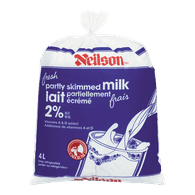
I’m driven to such fantasies by the difficulties I face obtaining milk in local stores. My requirements are simple: I want healthful, safe, and tasty milk for a reasonable price in a simple, sensible, rigid container with a reclosable top. Modest desires. What I can get within my budget at grocery stores, however, is a floppy plastic bag filled with white liquid. Yes, that’s how most milk is packaged in Canada, or at least in Ontario. After five years here, I'm still shocked.


It’s like this.  Three 1.3L transparent plastic sacs of milk are nestled into one large colourful bag whose top is secured with a twist-tie, making up four liters in total. At home, the hapless consumer wrangles one of the three small bags into a small container with a handle (purchased separately for the purpose), leaving the top of the bag poking out, but hopefully not too far out, because then one snips off the corner of the milk bag with scissors, or if they are missing, a knife. Too small a hole and the milk won’t pour, but too large a one leads to messy overflow. It’s sloppy even with a perfectly-sized hole (I'm told, not having achieved such nirvana myself) because some drops of milk will always dribble down between the bag and the container’s interior. Almost nobody washes out the jug between bags.

And in a family of five, a liter-and-a-bit sac of milk empties in day or less, triggering the annoying rigamarole of Changing the Bag with great frequency. A sort of hot-potato game evolves, to avoid finishing off the last of the milk, at least when there are witnesses. (Where are those damned scissors? Oh never mind, I'll just have green tea. Even though it tastes like dirt.) And, adding insult to injury, the milk is left in the fridge with its gaping hole, easily spillable, and, you know, open. Yuck.


It's a crazy state of affairs, I tell you.


Why is it thus? I asked the locals when we first arrived in Canada, to no avail. I present my case: milk is a fluid, gravity exists, plastic bags are flexible and pierceable and really pretty unsuited to the transportation and service of milk. Shrugs. I, however, have not accommodated. My irritation and annoyance have only grown with the passage of time. 

Milk in cartons can be had, albeit at double the price:


Milk in bags (4L):                                     Milk in cartons (2L):


$3.97 ea ($.10/100 mL) $4.39 ea ($.22/100 mL)


Hence, the recent bright idea of starting my own dairy herd.

Luckily, though, in the nick of time, someone mentioned to me Mac's Stores. I was already vaguely aware of this chain of convenience stores with a winking red owl as their logo. Apparently, went the rumour, Mac's were allowed, by special dispensation from the Queen or some such (I made that up) to sell milk in 4-liter rigid (though still plastic) jugs. I ventured in one day, and sure enough, it was true! Four liters of milk in a decent-sized container WITH A TOP. At the moment such treasure costs $4.99, plus a returnable 25 cent deposit. Calloo, callay!

All is not perfect, however. Perish the thought. Mac's stores in Toronto generally do not have car parks attached, so acquisition is a bit tricky, and outings to purchase milk have come to seem like surreptitious forays for contraband. Psst. Got any 2% left? Often I swing by the Mac's on a corner near my office, riding my bike. I can fit two 4-liter jugs in the basket.There's another Mac's just next to the orthodontist's office with street parking nearby, if it's before 4:00 pm.

It may not be the Queen herself who issues the Dairy Decree, but the Government is involved in regulating milk packaging. In fact, Container Controversy still rages. A year or so back, Mac's wanted to sell milk in three-liter containers. Horror! The Ontario dairy industry along with various provinicial ministries reacted strongly against this apostasy:

http://www.thestar.com/news/gta/2014/12/11/its_official_you_can_buy_3litre_milk_jugs.html

I can't help but think they are all totally nuts, but as long as i get my fix of milk in a container that respects gravity, I will be satisfied. At least I'm not entirely alone, as I discovered recently:

http://www.producer.com/2014/08/ontarios-great-milk-jug-debate-puts-dairy-industry-in-odd-situation/

The most recent twist in the story has me a little scared. Mac's Stores are being taken over by a US-based chain called Circle K. Their logo is, unsurprisingly, a letter 'K' inside a circle. Farewell, then, to the winking owl. I can live with that. But I am on tenterhooks waiting to find out whether they will still sell milk in jugs. Until I can be certain, I'm keeping my eye on the price of Jerseys.


Wednesday, 7 October 2015

Great lake


When I was a map-reading child, I loved the idea, the sound, of a region called 'the Great Lakes'. Why couldn't we refer to California as 'the Wonderful West'?

Now that I actually live here, the Great Lakes often disappoint me, even though I came to understand that 'great' refers to their size, not their aesthetic supremacy (or Superiority). However, last month, en route home from a work trip to Kingston, Ontario, I decided to stop in Prince Edward County, because so many people had told me of its loveliness. Yeah, yeah, yeah, I thought, dubious. I have not been overly impressed by the local landscape. (Well, okay, Niagara Falls deserves its rep.)

I had toted my bike from home all the way to Kingston, 300 km away, on the back of the car, which I now parked in the small town of Picton. After a frugal lunch of tuna salad sandwich in the bookshop cafe, I rode the 15 km to Sandbanks Provincial Park, on the shore of Lake Ontario.

All of it impressed me: the cute town of Picton, the kindness of its bookshop employees (here, hey said, take my map), the rolling agricultural landscape of the county, the judicious sprinkling of art galleries, and finally the widely dramatic sweep of the lake beach at Sandbanks. I sat there listening to the rush of waves for as long as I dared before dusk crept up, and then rode the 15 km back to my car.

It's not the Amazing Pacific, but it will do. Quite nicely in fact.